MOLLY BLAZE
COSTUME DESIGN & TECHNOLOGY


The Story is Told in the Small Details
How do you help your audience know when the curtain opens who is who?
How do they identify the lead, Joseph, from the pack of brothers on stage? My favorite part of costume design is in the smallest of details - putting a multi-color trim on an otherwise all-white base gives foreshadowing to the coat of many colors Joseph would soon be identifiably wearing. Putting him in the same base color as his father also stands both of them apart from the colored menagerie of his 11 brothers, as well as unites them visually. Before the plot has even unfolded, the audience is given visual markers to help them understand the scene before them.


Center Stage
The Narrator is one of the most vital roles in Joseph and the Amazing Technicolor Dreamcoat. Her presence initiates the audience's invitation into the world they're about to partake. She sets the tone; she carries one scene to the next. She provides both verbal and visual context to the unfolding story. As such, I knew it was important for this primary character who literally ALMOST NEVER leaves the stage to have a striking base look that could carry successfully from one scene to the next through the many and varied scenes of Joseph.
I gave her a base metallic gold jumpsuit that could easily receive accessories (often with the aid of dedicated blocking and a fellow actor while on stage) within the gold through-line color theme of the show. When in Canaan with Joseph's family, she had a complementary headpiece like that of the brothers' wives; when in Potiphar's palace, she received the additional modified blazer design and cummerbund to lead the chorus. When we first meet her, she's wearing a sheer overlay tunic adorned with golden images that metaphorically depict characteristics of the production, and when in "Elvis'" Eqypt, she received a very stylized, sheer overlay combination to reflect her surroundings.


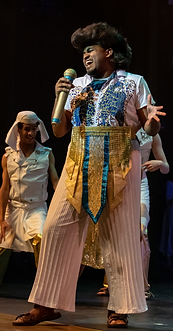

When Egypt...
...& Elvis Collide
Joseph and the Amazing Technicolor Dreamcoat was one of my finest moments of growth as a young Costume Designer. It challenged my ability to costume an outdated show that was comprised of a mash-up of both time periods and cultures in a way I had never before been faced. Leaning heavily into my God-given talent to read into the soul of the show and the varied details being portrayed, I was able to blend together both Ancient Egypt and 1950s Rockabilly in a cohesive, aesthetically appealing and choreographically functioning manner.
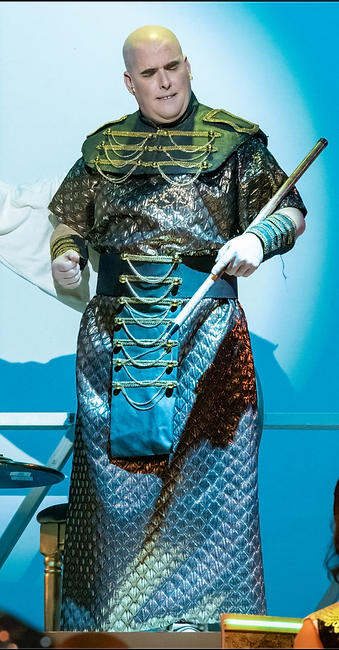

Pharoah's Kingpin
Potiphar was partially stylized after a "mob boss" Kingpin aesthetic, also leaning heavily on blending the characteristic garb of Ancient Eqypt with a militaristic nod. The design for him and his wife were a fusion of individual components to hearken to the ancient and the modern in a stylistic design.


A Closer Look at the Design
For Joseph's Brothers and their wives, I took the design approach of making "complementary sets" - I took pieces of fabric that coordinated with the overall palette I assigned to their base layers and added trims, bands, belts, created headpieces and head coverings and the like to make a husband and wife unit that could be recognized on stage as a pairing.

Joseph and the Amazing Technicolor Dreamcoat
Costume Designer/Technician/Supervisor/Craftsperson/
Milliner/Cutter-Draper: Molly Blaze (as Molly McKinley)
Director: Anthony McClure
Lighting Designer: Tyler Hutchinson
Photographer: Ronnie Sunker
Set Designer: Jared Thornton